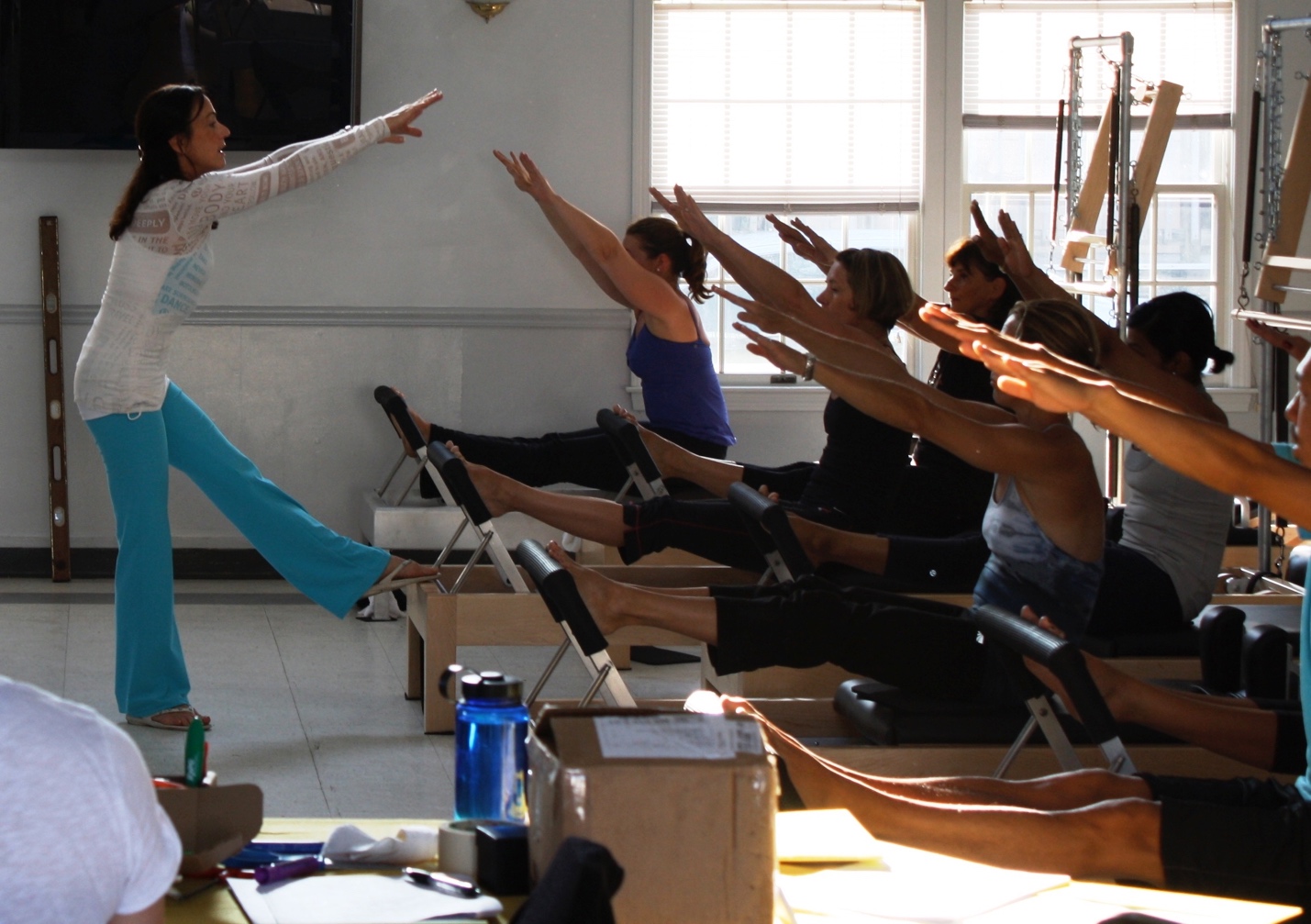
This article was originally written for and published on Pilatesology.com. I'm sharing it here because the conversation it started is one I want to keep going.
Your certificate arrives, and something shifts. You trained hard, learned the material, and can teach a session. But here’s what the best teacher trainers will tell you: your training is a floor, not a ceiling. It gives you the foundation to stand on. What you build from there — over years of real bodies, real sessions, real problems — is entirely up to you. Most seasoned educators will tell you it takes a good five years of consistent practice before teaching stops being something you do and starts being something you are.
And yet our industry has a habit of treating certification as the destination. We celebrate graduation, hand over the certificate, and send new teachers out into the world without a roadmap for what comes next. That gap has always existed — but it’s wider now than ever.
The erosion of supervised teaching experience
The rise of online teacher training platforms has made entry into the profession more accessible than ever. But accessibility has come with a quiet trade-off. Many of these platforms have reduced — or in some cases eliminated — the accountability structures around the in-person component of training. And in Pilates education, that component isn’t optional. It’s foundational.
There is simply no substitute for supervised teaching experience. Being in the room with a qualified teacher trainer or supervising instructor who can watch you move, watch you teach, and give you immediate, specific, technical feedback — that is where real learning happens. Hours logged are not the same as hours truly supervised. There’s a significant difference between a teacher who completed their training and a teacher who was genuinely seen, corrected, and challenged throughout it.
That gap may not be obvious to you at first. But it shows up — in the uncertainty of not knowing what you’re looking at when a real body is in front of you, in the reliance on cueing scripts instead of genuine observation, in the feeling that something is missing even when you can’t name it. The good news is that it can be addressed. It just requires intentionality — and knowing where to look.
The landscape is richer than you think
Post-certification pathways exist. They’re just not well signposted. Here’s how to think about them:
Credentialing is the clearest professional benchmark we have. The NPCP certification signals a serious commitment to the field, and the continuing education requirements built into maintaining it create a built-in structure for your ongoing growth. If you haven’t explored it, it’s worth a serious look.
Post-graduate programs, bridge intensives, and extended study with seasoned teachers are where some of the most transformative learning happens. Programs like those offered through Vintage Pilates, The Pilates Center in Boulder, Mejo Wiggin, my own Advanced Seminar, and others create the kind of immersive, apparatus-focused, supervised experience that cannot be replicated on a screen. These aren’t just workshops — they’re structured deep dives with teachers whose knowledge lives in their hands and eyes. If your original training left gaps, these are the places to fill them.
Continuing education workshops have their place too — but approach them strategically. The question isn’t how many hours you’re accumulating. It’s what you’re specifically trying to develop, and whether this experience actually addresses it.
Digital resources — the distinction that matters
Not all online platforms are created equal — and criticizing the erosion of supervised teaching experience is not the same as dismissing the value of digital learning resources.
There is a profound difference between an online platform that replaces your in-person training experience and one that enriches and extends your ongoing development as a teacher. Pilatesology is a perfect example of the latter. The depth and breadth of teachers, lineages, and knowledge that the Pilatesology platform has gathered and preserved over the years is genuinely extraordinary — a resource that no single studio or training program could replicate. Watching a master teacher work, returning to the same video at a different stage of your career, and seeing something entirely new — that is a legitimate and valuable part of your continuing education.
The question to ask of any digital resource is simply this: is it replacing the irreplaceable, or is it adding something that couldn’t exist otherwise? The answer tells you everything you need to know about how to use it.
The peer-to-peer layer most teachers skip
One of the most underused tools for your growth costs the least: your colleagues. Observation exchanges, study groups, video review with a trusted peer — these create a kind of accountability and honest reflection that solo practice never will. There’s a real difference between talking about your teaching and actually looking at it together. Think of it as a teaching date — equal parts revealing, inspiring, and energizing. It’s one of the best-kept secrets in professional development, and the teachers who do it can’t imagine going back. Grab a colleague or two, pick a session, and see what you discover. You might be surprised how much fun it is.
Mentorship in both directions
Here's where I want to slow down, because there's a genuine misunderstanding in our community about what mentorship actually is.
Mentorship is not advanced teacher training. It's not taking more classes or finding someone to give you the answers. It's a relationship built around inquiry, reflection, and growth that unfolds over time. A true mentor doesn't fix your teaching. They help you see it. If you feel those gaps, especially if your training was light on supervised hours, finding an experienced mentor for one-on-one work can be the single most impactful investment you make. Not another workshop. Not another credential. A relationship.
But there's a second direction to mentorship that most teachers never consider: learning to be a mentor yourself.
The skills are learnable. Developing them deepens your own teaching in ways that are hard to get anywhere else — and they open a distinct professional chapter, whether you're a studio owner building staff, a teacher trainer expanding your range, or an experienced teacher ready to play a bigger role in this field.
Before going further, it's worth separating three things we keep conflating. Technical feedback is the clearest: correction, placement, precision. Teaching feedback is harder — it requires someone to watch you in the room and help you see what they see. Most teachers have never been on the receiving end of it. After graduation, feedback on teaching tends to stop; what continues is feedback on technique. Mentorship is different in kind. The mentor's job is to stay curious about where you're headed long enough to ask the question that gets you there — not hand over the answer.
We train teachers to work with clients. We don't train experienced teachers to develop other teachers. That gap is where I want to put my energy.
Thursday, June 18. Zoom. 5:00 PM EST / 2:00 PM PT / 11:00 PM CET.
Mentorship as a Skill: A Conversation for Experienced Teachers
Register even if you can't make it live — the recording goes to everyone who signs up.
This is an open conversation. Come ready to think out loud. Whether you're stepping into a new role or just feel the pull toward something you haven't named yet.
In January 2027, Handspring Publishing will release my book Pilates Handbook: Tools for Developing Your Skills as a Teacher — a practical guide to self-assessment, peer feedback, and mentorship as an ongoing practice, for teachers across every Pilates tradition.
What moves you? Beyond the exercises, beyond the apparatus, what truly ignites your commitment to showing up for Pilates day after day?
After three decades of teaching movement—from my early days exploring various disciplines to my life's work in classical Pilates—I've discovered that the most transformative practices aren't just about building strength or flexibility. They're about something deeper: keeping our spark alive.
The Foundation: The A.B.C.'s of Movement
Before we explore what keeps that spark burning, let's establish the foundation. For me, whether I'm teaching on the Reformer, Mat, Chair, or any apparatus, three principles remain constant— my A.B.C.'s of movement:
Alignment - Finding your optimal relationship to gravity and space
Breathing - The bridge between body and mind, effort and ease
Conscious Awareness - Movement with purpose, not just going through the motions
These aren't just technical checkboxes. They're invitations to be fully present in your body, to meet yourself where you are today, and to move with intention rather than autopilot.
Beyond Exercise: Pilates as Re(creation)
Here's what I've learned teaching everyone from professional athletes to those just beginning their movement journey: Pilates isn't just about building core strength or achieving perfect form. It's about recreation (read re-creation) in the truest sense of the word—creating ourselves anew, taking a break from the relentless demands of modern life, and reconnecting with our inner vitality.
In today's fast-paced world, we desperately need spaces where we can step away from our routine stressors and rediscover what makes us feel alive. The Pilates studio isn't just a place to work out; it's a sanctuary for this essential re-creation.
The S.P.A.R.K. Philosophy
My approach to teaching—and to life—centers on helping people maintain their S.P.A.R.K.:
Self-Discovery - Being inspired, taking risks, trying new things. Every time you attempt a new variation or challenge yourself with a different piece of apparatus, you're discovering what your body can do. There's magic in that moment when you realize you're capable of more than you believed.
Passion - Igniting the imagination, awakening the senses. Pilates should never feel like punishment or obligation. When we move with awareness and curiosity, we awaken our senses and reconnect with the joy of embodiment.
Accountability - Taking responsibility for your health in body, mind, and spirit. This isn't about perfection or harsh self-judgment. It's about showing up consistently and honoring your commitment to your own well-being.
Recreation - Keeping your practice fun, fulfilling, and playful. Yes, Pilates is disciplined work. But it can also hold moments of lightness, humor, and play. Balance and joy aren't opposites of dedication—they're what make dedication sustainable.
Karma - Keeping yourself fit and healthy so you have more to give back to your family, friends, community, and work. When we tend to our own vitality, we become more present and generous with others. Self-care isn't selfish; it's how we sustain our ability to contribute to the world around us.
Holding the Space for Possibility
When I work with students, I hold open the possibility that they can do their best each day—that they can reach just a little further than they thought possible. I never allow negativity, self-doubt, or "can't" into the space. This isn't about forced positivity or ignoring limitations. It's about creating an environment where students feel supported enough to explore their edges, where they can meet challenge with curiosity rather than fear. I communicate this through body language, facial expressions, tone of voice, and most importantly, through my intention. I stay present in the moment, ready to turn an ordinary exercise into a breakthrough experience. Sometimes it's a perfectly timed cue. Sometimes it's catching someone's eye at just the right moment. Sometimes it's knowing when to push and when to ease off.
Meeting Yourself in the Moment
At its best, Pilates is a lifestyle choice that gives us the opportunity to meet ourselves in the moment. Not who we were yesterday. Not who we hope to be tomorrow. But who we are right now, in this body, with this breath, in this moment. Through consistent practice—whether on the Reformer, the Mat, the Chair, or any apparatus—we reconnect with our inner energy, our life force, and our commitment to well-being. We learn to move with the clarity of proper alignment, the creativity of exploring variations, and the charisma that comes from being fully embodied and present.
An Invitation
My invitation to you is simple: approach your Pilates practice as an opportunity for re-creation. Bring your A.B.C.'s—alignment, breathing, and conscious awareness—to every session. And nurture your S.P.A.R.K. through self-discovery, passion, accountability, recreation, and the recognition that caring for yourself allows you to show up more fully for everything else in your life. Because when we keep our spark alive, we don't just change our bodies. We transform how we move through the world.
This philosophy has guided my teaching journey from competitive swimming and lacrosse to earning my Physical Education degree, from exploring multiple movement disciplines to finding my home in classical Pilates under Romana Kryzanowska. It's shaped how I've created programs, trained teachers, and run my studio, Progressive Bodyworks, for more than two decades. But most importantly, it's what keeps me showing up to the work with fresh eyes and an open heart, ready to help students discover their own spark.
After 28 years of teaching Pilates, I still get butterflies of excitement when I step into the studio each morning. The polished equipment gleams with possibility, and I know that today, like every day, I'll have the privilege of helping people transform their relationship with their bodies. If you're reading this, you probably know exactly what I mean. That feeling of purpose that comes with being a Pilates teacher never really goes away – it just deepens with time. I remember my early days of teaching, when every client seemed to present a new puzzle to solve. I'd lie awake at night thinking about cues, modifications, and progressions. I wanted so badly to get everything perfect.
Now, looking back, I realize that this dedication to growth, this constant desire to learn and improve, is exactly what makes a great teacher. But I also understand something I wish I'd known back then: excellence isn't about perfection – it's about presence, connection, and continuous evolution. The most profound lessons I've learned came from quiet moments of discovery. Last week, I worked with Sarah, a client of ten years. Despite our long history together, she still surprises me with new insights. During our session, she was struggling with a simple roll-up, an exercise she usually performs beautifully. Instead of pushing through, we paused. As we explored the movement together, she revealed she'd been holding tension from a challenging work project. This reminded me of a crucial truth: our bodies tell stories, and our role as teachers is to listen and respond with wisdom. Just yesterday, another moment crystallized this truth. Maria, a newer client who had been frustrated by her inability to find her powerhouse, suddenly lit up during footwork on the reformer. "I feel it!" she exclaimed, "It's like a corset of strength from the inside!" Her discovery came not from my technical instruction, but from a metaphor that emerged naturally in our conversation about her grandmother's vintage clothing. These moments remind me that great teaching often means stepping back from technical perfection and instead helping clients find their own path to understanding.
The journey of a Pilates teacher is uniquely rewarding because it demands constant growth in multiple dimensions. Technical expertise forms the foundation, but emotional intelligence, observation skills, and adaptability are equally crucial. Every client I've worked with has taught me something valuable about teaching, about movement, and about the incredible depth of the Pilates method. One of the most valuable lessons I've learned is the importance of maintaining my own practice. It's easy to let this slip when teaching schedules get busy, but I've discovered that my personal practice is the wellspring from which my teaching flows. When I make time to explore movement in my own body, my teaching naturally becomes more nuanced and insightful. The beauty of the Pilates method lies in its endless depth. Just when you think you've mastered a principle, you discover a new layer of understanding. This continuous unfolding keeps our teaching fresh and exciting, no matter how many years we've been practicing. As I watch my clients grow stronger and more confident in their bodies, I'm reminded of why I fell in love with teaching Pilates in the first place. It's not just about the physical transformations – though those are remarkable. It's about helping people discover their own strength, capability, and potential. Each day brings new opportunities to deepen our understanding, refine our skills, and make a meaningful difference in our clients' lives, one lesson at a time.
The small weights, which weigh only 1-3 pounds (or .4-1.3 kilos), might seem like nothing, but these tiny little weights can pack a punch for our posture muscles in the arm weight series. The complete series consists of ten exercises and takes about 8-10 minutes. Repetitions are kept at about 3-5 and include a variety of positions and different relationships to gravity. The movements are simple, so most cues given after the exercise directions relate to nuances in posture, alignment, or breathing. This series can be used as a warm-up or an ending to your mat or apparatus classes and is appropriate for almost all populations. Try pairing this series with the Wall Series for a complete posture mini-workshop.
The standing work, including the arm weight series (shown here), standing magic circle, wall, and other standing balance/strength/agility movements, was an essential part of Joe’s repertoire, and Romana included them regularly. Challenging the body upright in the gravity field without spring and apparatus assistance shows us where we’re strong and weak. For all the standing exercises, the requirement is complete coordination of the body with the entire focus of the mind. Romana would smile knowingly and chuckle as she watched us sweat and try hard to master these skills. She gave the Arm Weight Series to improve our standing posture and placement and to help with a graceful carriage. It also tones the arms, reinforcing the arms working from the back, which makes for a beautiful, strong back.
The setup begins with a posture checklist, allowing you to teach the essentials of standing and total body placement from the feet to the head. Begin the series with the feet parallel and hip width. Then, use the following 7 points to focus on posture details you can reinforce as you move during all the upright movements.
Weight is distributed 50/50 between both feet.
The center of the hip (ball and socket joint) over the front of the heels
Lower abs are pulling in and up, the tailbone lengthening straight down
Collarbones and shoulders over the ball of the feet
Ribcage flush with the ASIS
Sternum lifted
C7 aligned with the occiput
Each exercise has two parts: the contract phase and the resist phase. However, keep the main focus on posture! You’ll notice so many little things as they move, and that’s when you can offer suggestions to “lift taller,” “check your weight distribution,” etc., cueing within the rhythm of the movement. Work at a pace that isn’t too slow or fast, and be clear about your tempo.
Keep it moving by establishing a solid rhythm and dynamics and add a balance periodically for added challenge.
The sequence below follows the order of Romana (circa 1995). Between exercises, there is a spine release. Release the spine by hanging over with bent knees and slowly rolling up one vertebra at a time, allowing the weights to increase the spine stretch while the abdominals assist the lift when rolling up. The breath is full, deep, and natural except in the side bend and chest expansion, where a directed breathing pattern increases the effect of the movement. The exercises are listed below, and the short video follows.
The Exercises
Biceps: biceps curl with a wrist extension at three heights: shoulder height, low, side
Boxing: The stance is parallel at hip width. Flat back hinged at the hips. Elbows bent, palms up under shoulders. The right arm extends forward palm down while the left extends back palm up. Both arms return. Change sides.
(Spine release*)- Release the torso down over the thighs to relax the spine. Roll up slowly one vertebra at a time until the head lifts last.
Side Bend: Pilates stance. Start with one arm next to the temple and the other arm down at your side. The exercise is in four counts.
1. Bend side 2. Fold the arm around the head
3. Return to center 4. Switch arms
Spine release: Release the torso down over the thighs to relax the spine. Roll up slowly one vertebra at a time until the head lifts last.
Bug: Parallel stance. Hinge forward at the hips, keeping the spine straight and the knees slightly bent. Arms are rounded, and they both lift and lower (like the hug)
(Spine release*)
Zip up: Pilates stance. Both hands move up like a zipper to mid-chest.
Shave: Pilates stance. Both hands together behind the head to lift and lower.
Triceps: Parallel stance. Hinge forward at the hips with the spine straight and the knees slightly bent. Arms hang down; then biceps curl in and out. Arms straighten, extend back, and extend the wrists. Lower to start position.
(Spine release*)
Chest Expansion: Arms at chest height. Pull down and back (inhale). Turn the head right and left (hold your breath). Return arms forward (exhale).
Sparklers: Hold the weights at the bottom. Circle outwards 8x raising the arms forward and 8x circling inwards, lowering.
Side Lunge: Lunge diagonally as the arms raise to the ears. Hold that position as the arms lower to the hips and up to the ears. Then, step back in one motion. Change sides.
*Spine Release: Release the torso down over the thighs to relax the spine. Roll up slowly one vertebra at a time until the head lifts last.
This article was initially published in the Pilates Intel Newsletter on Oct. 18, 202,3
Breast cancer is a disease that affects many people, either directly or indirectly. The Pilates method is believed to be an excellent system for post-surgery recovery as it helps increase circulation and slowly regains range of motion, strength, and stamina. However, physical recovery after breast cancer treatment might not always be easy and can leave many women wondering how to care for themselves after surgery. Fatigue, limited range of motion, and fear of sore areas may discourage them from exercising, and finding a trained therapist to help them through this time is not always possible.
Lissa Curtis, BS, a certified Pilates teacher, and Naomi Aaronson, MA OTR/L CHTc, collaborated with me on this project to address this issue and provide a solution. We aimed to create a FREE video for women recovering from breast cancer surgery, which they could do at home six weeks post-surgery after their introductory physical therapy sessions. This video has helped thousands of women since its creation over a decade ago. Yet, it has stood the test of time.
Volunteering my services for this cause was an opportunity to support community education and awareness of resources to help cancer patients in their physical and mental well-being and recovery. We named this video "Passionately Pink! Pilates," reflecting our passion for finding a cure. This exercise routine is perfect for women 6-8 weeks post-surgery and has been given the go-ahead by their doctor to exercise. The workout is divided into two parts, and it's gentle and mindful, created especially for them. Let's welcome them back to their bodies!
This exercise routine is suitable if you are about 6-8 weeks post-surgery and your doctor has given you the green light to exercise. Divided into two parts, this workout is gentle and mindful, created just for you. Welcome back to your body.